PHILIPPINES - NOTHING TO DO WITH RADIO
EXCEPT FOR THE MAPS, PICTURES CAN BE SHOWN 1024 X 768 BY CLICKING ON THEM
THE START OF AN EXPERIENCE
I have just been to the Philippines. It was not a conventional tourist trip and I would challenge you to follow in my footsteps. There are almost no areas in Australia like the suburbs of Iloilo City. We would not even call them suburbs. They call them "squatters areas" which constitute most of Molo and San Juan and other areas although some areas are better than others. My first two nights in Iloilo City were in a motel protected by armed guards. This fellow's pistol is on his right hand side and can't be seen. Every shop, mall, bank or business is protected by such guards, some of them toting pump action shotguns. The Australian embassy in Manila, along with several other embassies in the same building, were protected by the same shotgun carrying guards but also by some with automatic rifles. | 
|
TRIP WITH A DIFFERENCE
I read a travel review before I left. It said:-
When you land in Manila it is a real dump. When you get out of Manila, the rest of the country is not so bad.
The author of the review had gone to Boracay from Manila. Boracay is simply a small piece of California or Australia's Gold Coast transplanted to the Philippines and put there solely to get money from stupid westerners. It is NOT the rest of the country. People who say this sort of thing have NOT seen the Philippines. They have seen a small piece of some western country transplanted.
I stayed with the people. How I managed that is another story. Each marked square is the area of the next map. The yellow cross on the last map shows where the photos of the road to Calumpang below were taken.

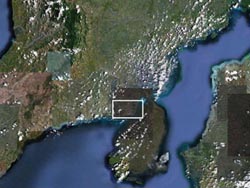
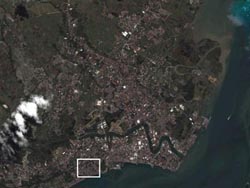

Coordinates for Google Earth to explore for yourself -> 10.6883,122.546
Or if your browser will open or download KML files click here
I have not put the place I stayed at the exact centre for privacy reasons.
FIRST IMPRESSIONS
 
| Unfortunately I had to turn my camera off as the plane landed in Manila. It does look like a real dump compared to anything in Australia except for some of the more remote indigenous housing. People are living in huts supported by poles over the rivers flowing through Manila. Every sign of a corrugated iron roof is rusted. There is no new iron to be seen anywhere except on the airport buildings. It is strongly advisable not to leave Manila airport unless in a car. Don't take the special airport taxi either. Get a private one. You will get slugged something like 700 pesos where a private taxi will only cost less than 100. More about taxis later. As it is, I didn't leave the airport the first time in Manila but went directly to Iloilo. (Pronounced somewhere between EE LOO EE LOO and EE LOW EE LOW. They use American, not Australian, vowels.) |
FIRST DAYS IN ILOILO
 |
My first two nights were spent in a hotel. The city corporate inn is not expensive at 695 pesos a night (that's about A$15 - A$20 depending on current exchange rate.) There is the armed guard at the front door (shown above) and plenty of barbed wire protecting the perimeter. But where do you go from there? It is better if you get a local to book it for you though. If the inn knows you are a foreigner, they will charge more. |
  |
TRANSPORT
  |
Throughout the streets of the cities I visited and even in the country areas, there are 4 forms of transport. There are some private cars but these are outnumbered by Jeepnies (shown at left), especially in Iloilo.
There are also cycles everywhere (right). Everybody does something (there is no dole payments) so if nothing else, people make their living by taking passengers on short trips. |
 |
 | There are also motor cycles with side cars everywhere. These are motor cycles in the 100cc range with side cars attached. Overloading is when they fall over or fail to move as the picture at right demonstrates. Not so obvious is the overloading on the tricycle at left. I was helping establish a mango farm on Guiramas Island. This tricycle does not look so overloaded but there are 25 mango trees strapped to the back and 3 people you can't see very well. I am the one with the white shirt. The driver and a male passenger on top are also easy to see. What is more difficult is the woman next to me and the woman and child riding pillion on the back of the motor cycle and hidden by the side car. |
 |
We went half way across Guiramas Island like this. By Australian standards, the police would never allow such a thing. I felt safer though on this side car than I do on Australian roads. All those capable of driving are those that drive. They are remarkably good at not hitting things. Unlike Australia, the lousy drivers are soon pushed off the road.
The only road rules seem to be, "sort of stay towards the right hand side of the road if you feel like it and don't hit anything." Considering the population, the death rate on the roads is small. Drivers in Australia would learn a lot by trying driving in the Philppines. On second thought, not many Australians would be capable of it.
One might say, "what if a child runs out onto the road?" The answer is, "miss them." Children and animals are running onto the road with wreckless abandon all the time and they don't get hit. Honestly, Australian drivers are bloody hopeless.
STAYING IN ILOILO
I was very fortunate to stay with a family in Molo, Iloilo city. I think all of them for their hospitality, Inday, Neneng, Alanna, Skye, Darney, Pendy, Whamboy, Nanay and Nene. Thank you very much people. It was an honour to stay with you. These people are lucky enough to live in quite a comfortable house. There are "squatters" all around living in humpies though.
 |
 |
 |
 |
|
Breakfast - coffee and Pan De Sal. |
The kitchen. |
Cooking over charcoal. |
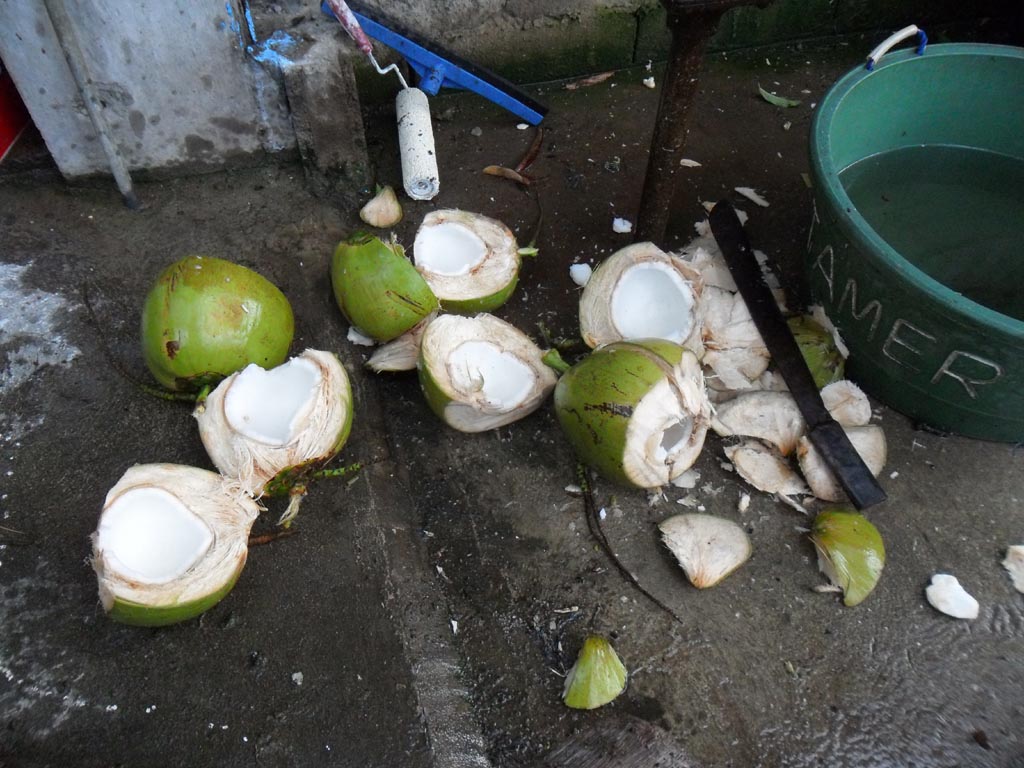
Fresh coconuts if you can get them. |
FRESH COCONUTS
  | And talking about coconuts, when you want them you just climb the tree and throw them down. If you can't climb yourself, you pay someone. Then - fresh coconuts and, of course, the coconut milk that goes with them |
 |
GENERAL MOLO AREA


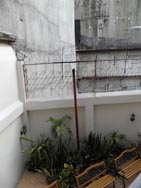
Just a few casual pictures from the top of the building I stayed in showing the general nature of the area.


This is just a simple surburban street. Children play, people walk or ride cycles.


This is equivalent to a main arterial road. It is the road to Calumpang from Iloilo. The metal arch across the road is the boundary of Boulevard and San Juan. These pictures were all taken near the yellow cross shown on the maps above.
ELECTRICITY SUPPLY
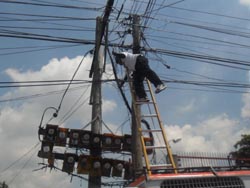
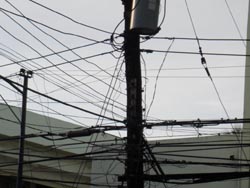
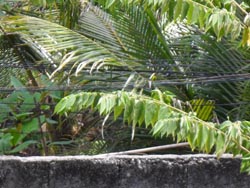
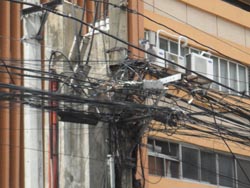
Australia is over governed and regulated but there is an argument for a few rules. In Iloilo there are power outages almost every day with good reason.
 |
 |
 |
 |
|
Note the sure footing, harness and electrical gloves. Note the power meters on the pole. |
Is this the phone line or 230v supply. |
Yes, this is the supply to other "houses" mixed with a little barbed wire so nobody touches it. |
Where does one connect the next wire. |
GUIMARAS - ON THE WAY THE FIRST TIME
 |
 |
 |
 |
|
The wharf at Iloilo. |
Shoving off. |
The wharf on Guimaras. |
Who said you weren't allowed to lift 100kg of rice onto a boat? |
THE PEOPLE OF GUIMARAS
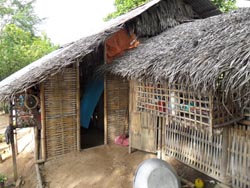
I was lucky enough to attend the festival of San Roque on Guimaras. These are the poorest of the poor living off the land in Nipa huts but what a life. They all seem happier than we are. There is nobody complaining about the taxes they pay because they don't earn enough to pay any except for a 12%Vat on everything they manage to buy. They work all day for almost nothing but wake up the next day, smile and just get on with it. Despite their poverty, they would have been insulted if I didn't visit them and eat something. To visit and eat something at one hut means you have to visit them all. This experience is not on the tourist maps. |
 |
 |
 |
 |
 |
 |
|
You MUST eat something. |
Neighbours, relatives and friends get together. |
On the way to the next hut where you MUST eat something. |
Shirts v no shirts. |
 |
 |
 |
 |
|
Shop fronts of Guimaras. There was an entire market behind this. |
Coconut palms. Imagine climbing one of these. |
Typical nipa hut in Guimaras countryside. |
Just a passer by. |
 |
 |
 |
 |
|
One of the better roads on Guimaras. |
Mango plantation. |
Typical rural setting (where I would like to retire.) |
Another typical Guimaras road. |